
Best Rear-Wheel Drive Push Mower 2026: Traction for Slopes and Full Bags
When you buy through the Amazon links on this page, we may earn a commission at no extra cost to you. Learn more
Last updated October 31, 2026
A rear-wheel drive push mower is a walk-behind whose back wheels are powered, so the machine pulls itself forward and the deck is pushed ahead of the drive instead of dragged behind it. That layout is what holds traction on a slope and keeps pulling as the grass bag gets heavy, and the Greenworks Pro MO60L424 is our top pick: rear-wheel self-propel, up to 3/4 acre per charge and 60+ minutes of runtime.
If you want gas instead, the Senix G-H-FIVE brings a 201cc engine and a 22-inch deck with the same rear-drive layout. A true push mower has no drive at all, so the phrase you searched for means a self-propelled walk-behind with rear-wheel drive.
The best rear-wheel drive push mowers of 2026

Greenworks Pro MO60L424 60V self-propelled lawn mower
See on Amazon
Greenworks Pro MO60L427 self-propelled lawn mower
See on Amazon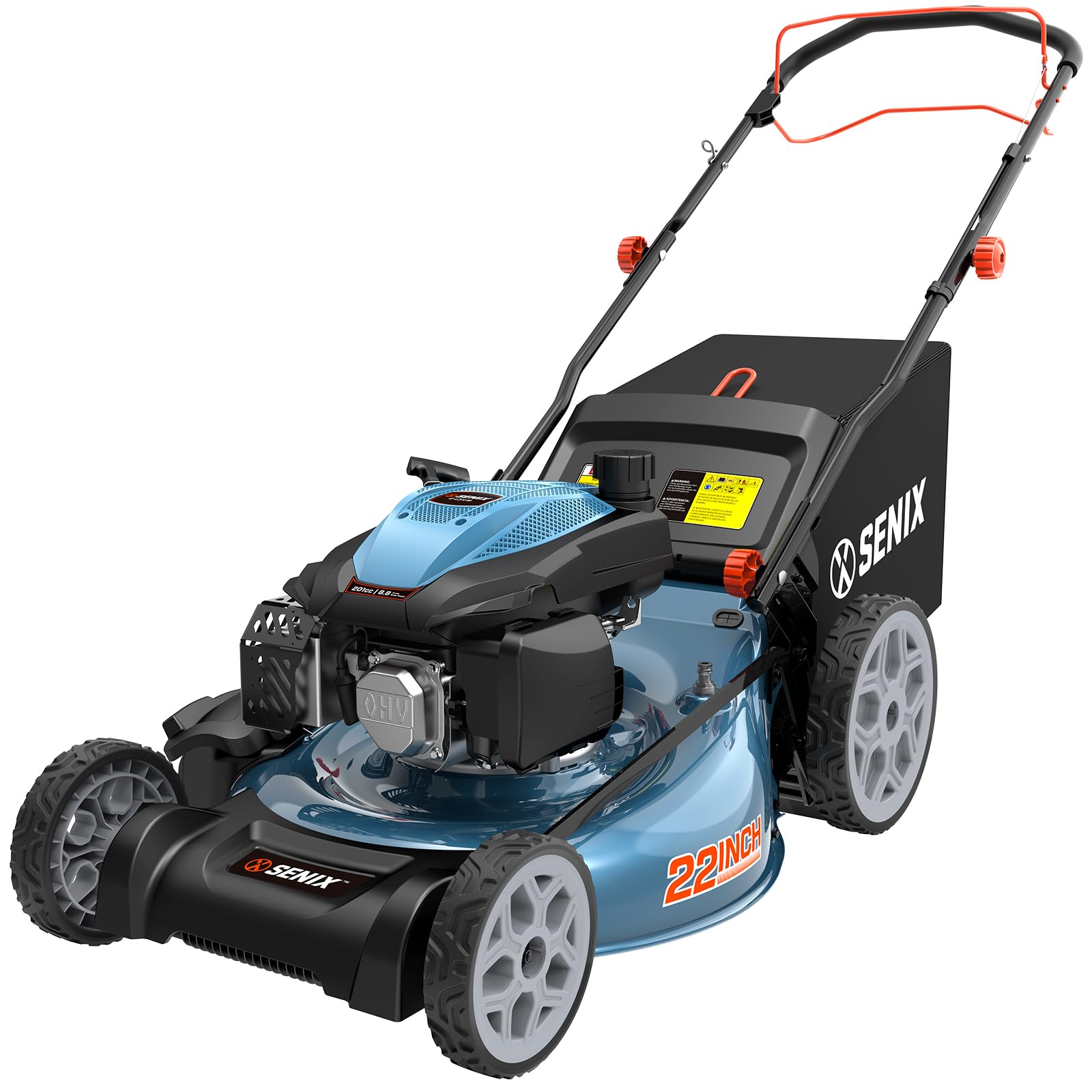
Senix G-H-FIVE 22in self-propelled lawn mower
See on AmazonModel comparison
| Model | Price | Rating | Weight | Voltage | Cutting height | Best for | |
|---|---|---|---|---|---|---|---|
| | Greenworks Pro MO60L424 60V self-propelled lawn mower | $449.98 as of 10/31 See on Amazon | ★ 4.4 (650+ ratings) | 65 lb | 60 V | 1 to 4 in | Buyers with up to 3/4 acre who want rear-wheel drive for incline traction get 60+ minutes of continuous mowing from the 60V 4.0Ah battery. |
| | Greenworks Pro MO60L427 self-propelled lawn mower | $529.99 as of 10/31 See on Amazon | ★ 4.3 (300+ ratings) | 67.2 lb | 60 V | not stated | Large-lawn owners wanting the widest rear-drive cut here get 23.96 inches and variable speed from 3.5 to 4.5 MPH. |
| | Senix G-H-FIVE 22in self-propelled lawn mower | $519.00 as of 10/31 See on Amazon | ★ 4.3 (400+ ratings) | 72 lb | not stated | 1.25 in to 4 in | Homeowners with larger or thicker grass, slopes or a bagging habit get gas power, a 22-inch metal deck and rear-wheel self-propel. |
 | Greenworks MO48L520 self-propelled lawn mower | $449.99 as of 10/31 See on Amazon | ★ 4.2 (750+ ratings) | 77 lb | 48 V | not stated | First-time battery mower buyers on lawns up to 1/4 acre get variable-speed rear-wheel drive in a lighter-duty package. |
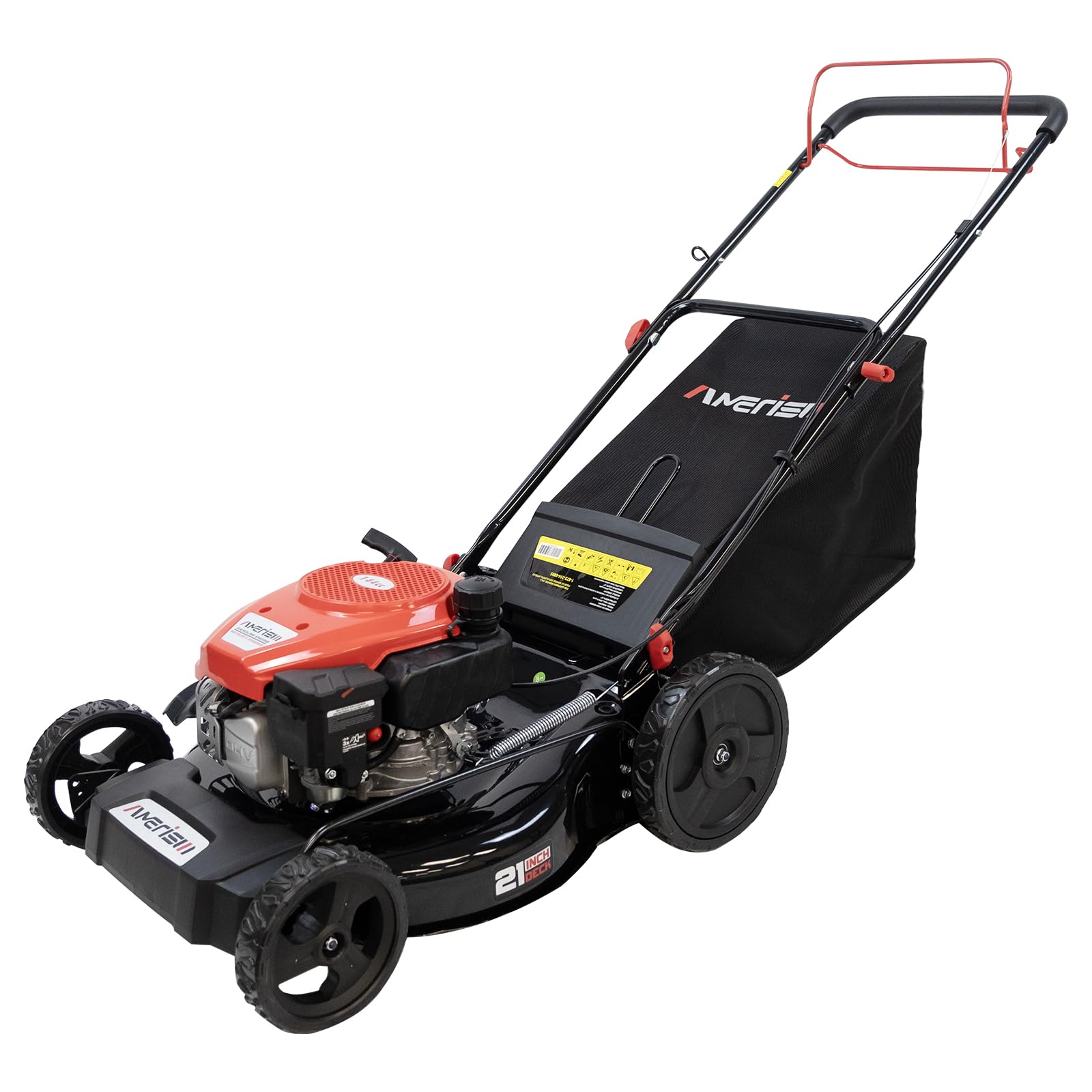 | Amerisun AV8621S1 21in self-propelled gas lawn mower | $339.99 as of 10/31 See on Amazon | ★ 4.0 (30+ ratings) | 66 lb | not stated | 1.5 to 3.9 in | Budget-minded buyers wanting rear-drive traction without batteries or variable speed get a 170cc gas engine and 21-inch deck. |
How rear-wheel drive changes the way you push a mower
On a rear-drive walk-behind, the engine or motor turns the two back wheels, so the machine pulls itself forward from behind. The deck is pushed ahead of the drive rather than dragged behind it. On flat ground the practical effect is that you supply steering and balance, not forward effort: the handle mainly guides, and your arms stop doing the work of moving 70-odd pounds of steel and grass.
Because the front of the deck is being pushed rather than pulled, the front edge rides lighter. That matters at the lip of a rise or on soft turf after rain, where a heavy front end tends to dig in and scalp the grass. A lighter front end skims over the transition instead of gouging it.
The drive engages through a control on the handle, which can be a bail you squeeze, a bar, or palm pads depending on the machine. Let go and the drive disengages, so the mower rolls freely. That free-roll is what makes the machine manageable at the end of a row and what you rely on every time you turn.
Why rear-wheel drive grips better on slopes and wet grass
Traction comes down to how much weight sits over the driven wheels. On a rear-drive mower the powered axle sits under the bulk of the engine or motor and the rear of the deck, so the tires carry load by design rather than by luck.
Point the mower up an incline and the machine's weight shifts rearward, which loads the drive wheels further. A front-drive mower does the opposite: climbing lifts weight off the powered front wheels, and they start to slip just when you need them most. That is why a rear-drive machine keeps climbing where a front-drive one spins.
Wet or dewy grass follows the same logic. The driven wheels are the ones with the most weight pressing them into the turf, so they are the last to break loose. Traction is not a substitute for safe practice, though. Drive type helps on a grade but does not make a wet slope safe, and the slope guidance in your mower's manual still sets the limit you mow within.
How a full grass bag actually helps a rear-wheel drive mower
The grass bag hangs at the back of the deck, directly over or just behind the driven axle. As the bag fills, its weight adds to the load on the rear tires, so traction improves through the mowing pass instead of fading. The mower is heaviest over its powered wheels exactly when it is carrying the most clippings.
That is why bagging on a slope stays steady with rear drive. A front-drive mower puts the catcher at the far end from the driven wheels, so a filling bag unloads them as it gets heavier, and the machine gets looser the longer you mow.
Bag capacity and the bag's position vary by model, so the effect is strongest on mowers whose catcher sits squarely over the rear axle. Check where the bag hangs before you buy if bagging on a grade is your main reason for wanting rear drive.
Turning and maneuvering with rear-wheel drive
The trade-off of rear drive is that the powered wheels resist pivoting. They want to keep rolling straight, and a driven axle fights a tight turn in a way a free-rolling one does not.
Technique for tight turns
Release the drive control before a tight turn so the mower free-wheels, then pivot on the rear wheels. For trimming around beds and trees, slow the ground speed rather than fighting the drive. To reverse, disengage the drive and pull the mower back on its rear wheels.
Why variable speed helps
Variable-speed and hydrostatic drives make maneuvering easier than a single-speed drive, because you can drop to a crawl instead of stopping and starting. On a single-speed machine, every adjustment around an obstacle means releasing the control and re-engaging it.
Protecting the turf
Pivoting a driven rear axle on soft or wet turf can scuff or rut the lawn. Turn on firm ground where possible, and avoid pivoting in place on ground that is already holding water.
When rear-wheel drive is the wrong choice
Rear drive earns its keep on slopes, wet grass and heavy bagging, and it costs you in maneuverability and often in weight. On a small, flat, obstacle-dense yard, pivoting around beds and trees matters more than traction, and a front-wheel-drive or lighter self-propelled design turns more easily there.
It is also a poor fit for anyone who mows steep side-slopes. On ground that steep, the safe answer is often a different machine class entirely rather than more traction on a walk-behind, and no drive system turns a bad slope into a safe one.
Judge fit before you buy. If your lawn is flat and cluttered, rear drive is solving a problem you do not have, and you will notice the harder turning every single mow.
Our picks by budget
The Amerisun AV8621S1 is our budget pick because it delivers the one thing this guide is about, a driven rear axle, along with the core mowing functions and nothing you do not need.
The Greenworks MO48L520 is our mid-range pick because the step up buys variable-speed rear drive and a battery power source, plus a 4-in-1 cutting system and seven cut heights.
The Greenworks Pro MO60L427 is our premium pick because the top of the range adds width, variable speed in the 3.5 to 4.5 MPH band, dual-blade mulching and the longest warranty on the page.
Budget
Mid-range
High-end
Which rear-wheel drive mower for which lawn
Matching the mower to the lawn matters more than the spec sheet, because a wide cut on a small lot is wasted and a short run time on a big one is a chore.
Large lawn, fast finish
Variable speed and dual-blade mulching mean fewer passes and finer clippings. The 4-year tool and battery warranty is offered here.
Big lawn, battery preferred
Up to 3/4 acre per charge and 60+ minutes of runtime cover a large lot, and the 4-in-1 system, LED lights and IPX4 construction handle varied conditions. EZ Fold storage helps in a tight garage.
Gas loyalist, simple layout
A 201cc 4-cycle engine, 22-inch deck and single-speed rear self-propel give you rear-drive traction with a proven gas layout. Refuel and keep mowing without battery management.
Smaller lawn, first battery mower
Variable-speed rear drive, a 4-in-1 system and seven cut heights in a package rated for up to 1/4 acre. Two batteries and a rapid charger come in the box.
Lowest outlay, still rear drive
A 170cc OHV engine, 21-inch steel deck and rear-wheel drive at the entry point of the range. Folding handles and a 66-pound body keep storage simple.
Our verdict on the best rear-wheel drive push mowers
Rear-wheel drive is the right drive for a slope, a wet lawn or a heavy bag, and the wrong drive for a flat, cluttered yard where pivoting wins. The Greenworks Pro MO60L424 is our top pick for the broadest set of rear-drive buyers, with up to 3/4 acre per charge and 60+ minutes of runtime. The Amerisun AV8621S1 is the value pick for the lowest outlay, and the Greenworks Pro MO60L427 is the pick for a large lawn where the widest cut, variable speed and the longest warranty matter most.
- Top pick: Greenworks Pro MO60L424 for up to 3/4 acre per charge and 60+ minutes of runtime.
- Value pick: Amerisun AV8621S1 for rear drive at the entry point.
- Battery-first pick: Greenworks Pro MO60L424 for up to 3/4 acre per charge.
Detailed model analysis
Rear drive pays off most on a grade and under a filling bag, and it costs you maneuverability, so the lawn you mow decides whether the trade is worth it.
Greenworks Pro MO60L424 60V self-propelled lawn mower
Up to 3/4 acre per charge with 60+ minutes of runtime. Rear-wheel drive suits a large or sloped yard, which gets a full pass without a recharge break.
It runs on a 60V lithium-ion system with two 4.0Ah batteries and a dual-port turbo charger. The brushless motor spins the blade at 3200 RPM, and there are seven cut heights.
IPX4-rated waterproof construction and LED headlights allow early or late mowing. The rust-proof aluminum handle folds vertically with EZ Fold for storage.
The mower weighs 65 pounds, and the warranty runs 4 years. The batteries also run 75+ tools in the same 60V line.
At 68.89 inches long, it is the longest machine on this page, which matters if garage space is tight.
- Brand: Greenworks
- Voltage: 60 V
- Battery capacity: 4.0 Ah
- Cutting height: 1 to 4 in
- Weight: 65 lb
- Motor type: Brushless
Greenworks Pro MO60L427 self-propelled lawn mower
Variable-speed rear-wheel drive is the reason to consider the Greenworks Pro MO60L427. On a big lawn it means fewer passes and a steady pull, and you can slow down at a bed or a tree instead of stopping.
A TruBrushless motor turns dual blades that adjust power automatically. The dual-blade design gives better mulching.
The box includes two 4.0Ah 60V batteries and a dual-port rapid charger. High-intensity lights and rust-resistant aluminum handles complete the package.
It weighs 67.2 pounds. Both the tool and the batteries carry a 4-year warranty.
A heavy-duty mower thanks to the dual-blade deck and the extra width. The variable-speed drive is the feature you pay the step up for.
- Brand: Greenworks
- Voltage: 60 V
- Battery capacity: 4.0 Ah
- Drive: Self-propelled
- Weight: 67.2 lb
- Dimensions: 53.54 in deep, 27.56 in wide and 45.27 in high
Senix G-H-FIVE 22in self-propelled lawn mower
Gas power with rear-wheel drive. The Senix G-H-FIVE pairs a 201cc 4-cycle engine with rear-wheel self-propel. If you want to refuel and keep going rather than manage batteries, it puts the drive under the back wheels.
The cut is 22-inch on a metal deck, with 3-in-1 mowing. Six cut heights run from 1.25 to 4 inches.
The drive is single-speed, so there is no slow crawl for trimming. You release the drive control to turn or ease around a bed, then re-engage it, which means more stopping and starting than a variable-speed machine.
At 72 pounds it is heavier than the Greenworks Pro MO60L424 60V self-propelled lawn mower, the Amerisun AV8621S1 21in self-propelled gas lawn mower, and the Greenworks Pro MO60L427 self-propelled lawn mower.
- Brand: Senix
- Engine displacement: 201 cc
- Cutting width: 22 in
- Cutting height: 1.25 in to 4 in
- Drive type: Rear wheel self-propelled
- Weight: 72 lb
Greenworks MO48L520 self-propelled lawn mower
Variable-speed rear-wheel drive in a smaller battery package suits a first battery mower on a modest lawn. The recommended lawn size is up to 1/4 acre, and you can slow to a crawl around obstacles.
The 48V system (24V x 2) comes with two 5.0Ah batteries and a dual-port rapid charger, and it powers a brushless motor.
The 4-in-1 system covers mulching, rear bagging, side discharge and a turbo mode, with seven cut heights from 1 to 7 inches.
It runs about 30% quieter than gas, carries a 3-year limited warranty and shares batteries with 125+ tools in the line.
Battery life is about 45 minutes and varies with grass thickness, so it fits smaller lots better than large ones. At 77 pounds, it is also a heavy mower.
- Brand: Greenworks
- Voltage: 48 V
- Power source: Battery powered
- Runtime: 45 min
- Weight: 77 lb
- Dimensions: 61.97 in long, 21.65 in wide and 41.42 in high
Amerisun AV8621S1 21in self-propelled gas lawn mower
A rear-wheel drive entry point. The Amerisun AV8621S1 pairs a 170cc 4-cycle OHV gas engine with a 21-inch steel deck. You get the traction of a driven rear axle without paying for variable speed or batteries.
The engine has auto choke and a recoil starter. A heavy-duty blade handles the 21-inch cut, with 3-in-1 mowing.
Six cut heights run from 1.5 to 3.9 inches. The wheels are 7 inches in front and 8 inches in back.
The handles fold for storage, with a claimed 70% space saving. The mower weighs 66 pounds.
Recoil starting only, with no electric start. The 8-inch rear wheels are small, which shows up on rough ground. We see these as trade-offs of the tier rather than faults.
- Brand: Amerisun
- Engine displacement: 170 cc
- Cutting width: 21 in
- Cutting height: 1.5 to 3.9 in
- Drive type: Self-propelled
- Weight: 66 lb
Frequently asked questions
Buyers weighing rear drive usually want the drive system settled before they compare cut widths and power sources.
Is a rear-wheel-drive push mower self-propelled?
Yes. The back wheels are powered, which makes it a self-propel machine, so the mower moves forward under its own power while you walk behind and steer. You can still push it by hand whenever you want to.
Is rear-wheel drive better than front-wheel drive?
Yes, because the powered axle carries the engine or motor and the catcher, so the tires stay loaded while you climb. On flat, obstacle-dense lawns, front drive pivots more easily and may suit you better.
Do both rear wheels pull on a rear-wheel-drive mower?
On the models on this page the rear axle is the driven axle, so the drive is rear-wheel self-propelled. Check the product card for the model you are considering to confirm the drive layout.
Will a rear-wheel-drive mower tear up my lawn?
It can, especially when the ground is soft or holding water. Turn on firm ground where possible, release the drive control before you pivot, and avoid spinning in place on turf that is already saturated.
What slope can a rear-wheel-drive mower handle?
Drive type helps traction but does not make a slope safe. The slope limit in your mower's manual sets what the machine is rated for, and mowing across a slope rather than up and down is the safer habit.
Gas or battery for a hilly lawn?
Both appear on this page: gas in the Senix G-H-FIVE and the Amerisun AV8621S1, battery in the three Greenworks models. Battery brings variable speed and quieter running, while gas brings refuel-and-go simplicity.