
Best Front-Wheel Drive Lawn Mower 2026: Easy Turning on Flat Yards
When you buy through the Amazon links on this page, we may earn a commission at no extra cost to you. Learn more
Last updated October 31, 2026
The Yardmax YG2860 is the best front-wheel drive lawn mower for most flat yards: its 22-inch deck cuts wide, its 6-speed CVT lets you match pace to open turf, and its front drive wheels let you press the handlebar down and pivot around trees and beds. A front-wheel drive walk-behind pulls itself from the front axle, so on level ground you mostly steer while the machine does the work.
If you want a lighter, simpler machine, the Senix LSSG-M10-III trims the deck to 21 inches. The Senix A025054-A suits the homeowner who bags often, with a 1.7-bushel bag.
The best front-wheel drive lawn mowers of 2026

Yardmax YG2860
See on Amazon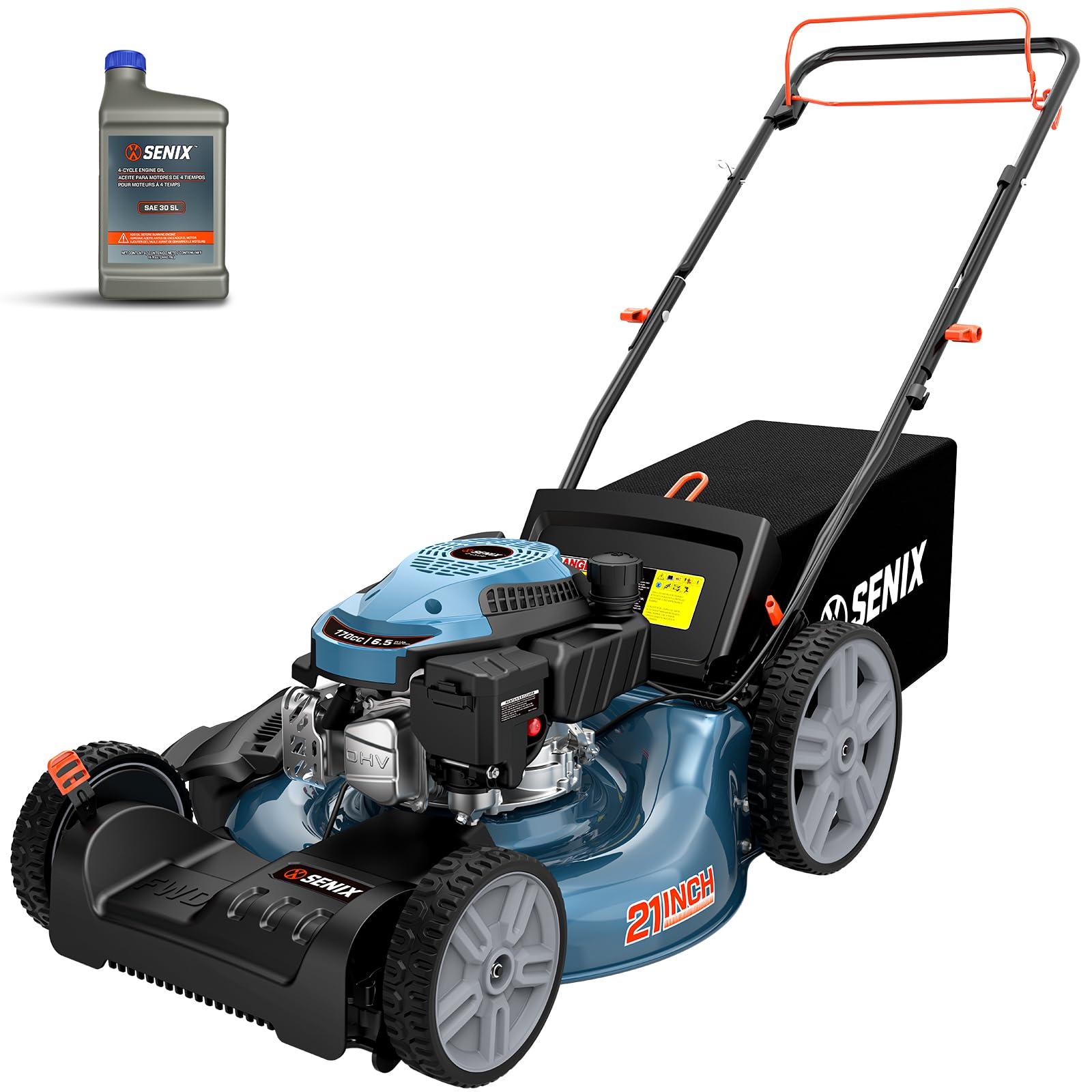
Senix A025054-A
See on Amazon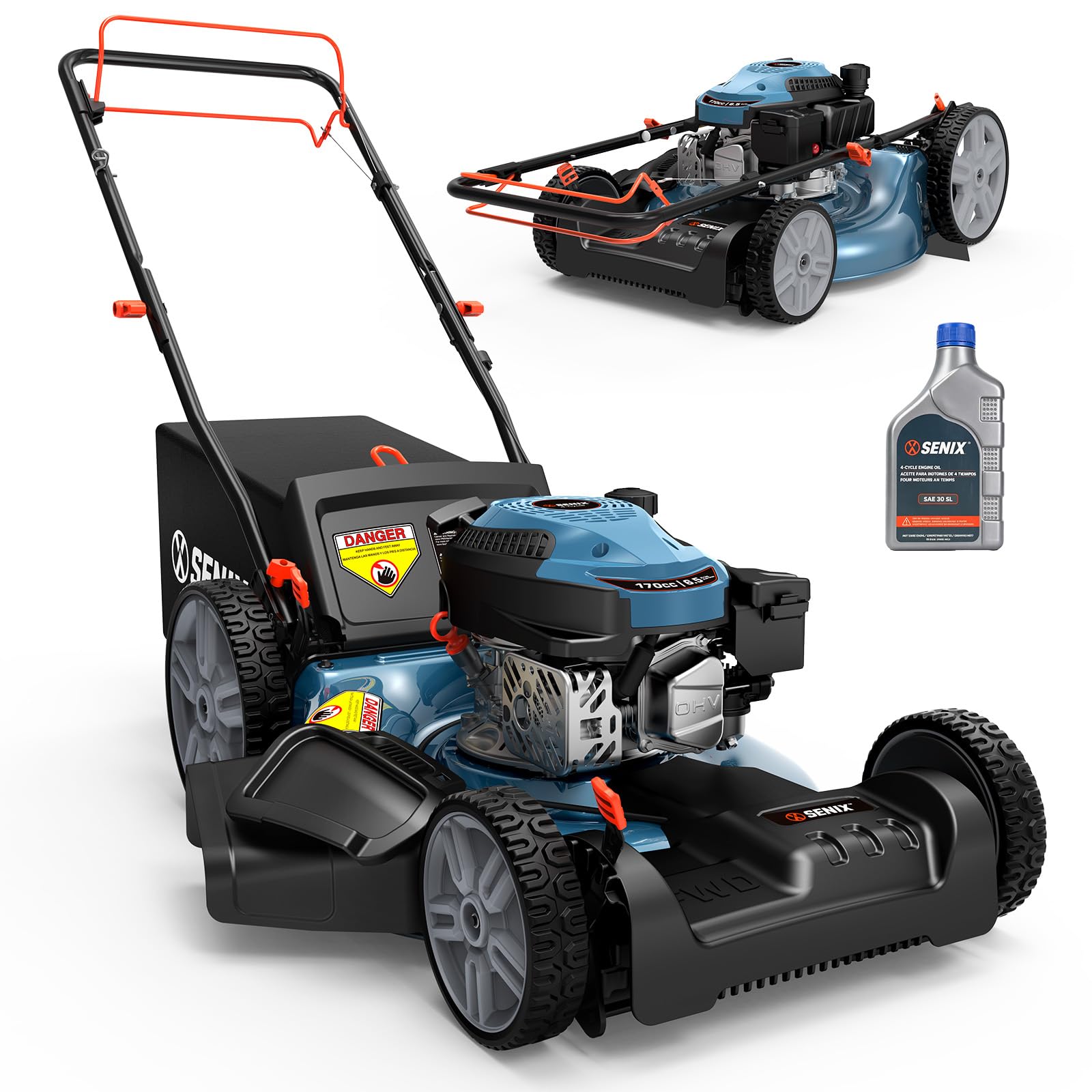
Senix LSSG-M10-III
See on AmazonModel comparison
| Model | Price | Rating | Engine displacement | Drive type | Cutting width | Best for | |
|---|---|---|---|---|---|---|---|
| | Yardmax YG2860 | $359.99 as of 10/31 See on Amazon | ★ 4.0 (450+ ratings) | 201 cc | Front-wheel drive | 22 in | Larger flat-lot owners who want pace control get a 6-speed CVT shift lever and a 22-inch deck for fewer passes. |
| | Senix A025054-A | $392.45 as of 10/31 See on Amazon | ★ 3.9 (550+ ratings) | 170 cc | Front-wheel drive, self-propelled | 21 in | Homeowners who bag clippings regularly on a flat yard get a 1.7-bushel grass bag and a stated 3.8 HP engine. |
| | Senix LSSG-M10-III | $379.99 as of 10/31 See on Amazon | ★ 4.7 (4 ratings) | 170 cc | Front-wheel drive | 21 in | Homeowners who bag only now and then want a lighter 61.7 lb front-wheel drive machine with 8-inch front and 11-inch rear wheels. |
How the front wheels do the pulling on a flat-yard walk-behind
On a front-wheel drive walk-behind, the engine turns a belt-and-pulley system that sends power to the front axle. Squeezing the handlebar bail pulls a cable that engages the drive, and the front wheels start turning under power. Some machines use a worm-drive transmission instead, a constant-mesh gear with a sliding clutch that engages when you squeeze the bail.
The result is that the mower is pulled from the front rather than pushed from behind. On flat turf the machine tracks forward under its own pull while you mainly steer and guide it. That is a different feel from a rear-drive mower, where the push comes from behind and the front end can wander.
The drive systems you will meet
- Single-speed cable clutch. The simplest layout: one speed, engaged by the bail. Fine for a small flat lot.
- Multi-speed or CVT. A lever or dial lets you match pace to the lawn, smoother on larger open runs.
- Worm drive. A gearbox with a sliding clutch, common on 21-inch front-drive decks, that holds a steady pull.
Here, front-wheel drive means a walk-behind self-propelled mower, not a front-engine riding tractor. The two share a name and nothing else.
Why front-wheel drive suits flat yards and tight turns
Press down on the handlebar and the front of the mower lifts. The drive wheels leave the ground, the drive disengages, and the machine swings freely on its rear wheels. That single move is why front-wheel drive is the easy-turning choice: you pivot the mower around a tree or a bed instead of wrestling it through a three-point turn.
The advantage grows with the number of obstacles. A yard with trees, flower beds, fence lines, narrow gates and lots of corners rewards the pivot on every pass. A lawn that is mostly open straight runs gets less from it, because you rarely need to swing the machine around.
On level ground the front wheels stay loaded, so the pull stays consistent from the first strip to the last. That steady front-end grip is what makes front-wheel drive feel planted on a flat lawn, and it is the reason the layout is common on entry and mid-level self-propelled mowers.
Where front-wheel drive loses grip and how to work around it
Traction depends on how much weight sits on the drive wheels, and a filling bag, a slope and soft ground each lift weight off the front wheels of a front-drive mower.
A filling bag
The grass bag hangs behind the rear axle, so as it fills it lifts the front of the mower and the drive wheels start to slip. A packed bag adds meaningful weight behind the axle. Empty it before it is full, or mulch and side-discharge instead of bagging when traction matters.
A slope
Going uphill, the mower's weight shifts rearward and the front wheels unload. Mow across a slope rather than straight up it, and treat steep grades as the territory of rear- or all-wheel drive.
Soft or uneven ground
Front wheels skip and spin more readily on wet or soft turf. Slow down and avoid mowing wet grass. Keep the drive cable adjusted so the clutch engages fully, and the front wheels will hold their grip on the ground they were built for.
How to confirm a mower is really front-wheel drive before you buy
Plenty of product pages leave the drive wheels unstated, and some marketing copy blurs the line between front and rear drive. A shopper can end up with a rear-drive machine without noticing. Check these places before you commit.
- The spec sheet. Look for a line reading Drive Type or Drive that says front wheel.
- Drive-wheel size and position. Front-drive mowers often show equal or smaller front wheels and a visible belt cover under the deck.
- The parts diagram. The drive belt and transmission route to the front axle on a true front-drive machine.
- The model number. Confirm it against the maker's own spec page, not a reseller's copy.
If the drive type is not stated, assume rear-wheel drive until the spec sheet confirms front. Front-wheel drive is the minority layout at the premium end and rare among battery self-propelled mowers, so verification matters more than ever.
Front-wheel drive upkeep that differs from rear-wheel drive
On a front-drive mower, the parts that carry the load are the drive belt, the front axle bushings and the wheel gears and pinions inside the drive wheels. A few simple checks catch wear before the drive stops pulling.
The drive belt
Look for glazing, fraying or slack. A worn belt is the usual cause of a drive that slips under load.
Cable adjustment
If the drive slips, turn the cable adjuster one turn at a time until it grips. Then confirm the drive still disengages when you release the bail.
Debris in the drive wheels
Grass and dirt packed into the dust cover, pinion and gear teeth cause a loss of drive. Pop the hubcaps and clean them out.
Pinion orientation
Drive-wheel pinions are handed, marked left and right. Reversed, the wheels will not drive, so keep each pinion on the side it came from.
Our picks by budget
The YG2860 is our budget pick because it puts a 22-inch deck, a 201cc engine and a 6-speed CVT within reach at the entry tier, with high rear wheels and a deck cleanout port.
The LSSG-M10-III is our mid-range pick because it trades deck width for a lighter, simpler machine: 21 inches, a 170cc engine and 8-inch front with 11-inch rear wheels.
The A025054-A is our premium pick because it adds bagging capacity and a stated power rating: a 1.7-bushel bag and a 170cc engine rated 3.8 HP.
Budget
Mid-range
High-end
Which front-wheel drive mower for which buyer
Matching the mower to the yard comes down to deck width, how often you bag, and how much weight you want to push around obstacles.
The large flat lot
A 6-speed CVT and a 201cc engine suit open runs where you want to control pace. High rear wheels with spiked tread keep grip on level turf.
The light and simple pick
A 21-inch deck, a 170cc engine and 8-inch front with 11-inch rear wheels make a machine that is easy to pivot. It bags occasionally and carries a 2-year limited warranty.
The regular bagger
A 1.7-bushel bag, a stated 3.8 HP rating and 6 cutting heights suit a homeowner who collects clippings on a flat yard and empties the bag before it packs full.
Our verdict on the best front-wheel drive lawn mowers
Front-wheel drive is the easy-turning, flat-yard layout: press the handlebar down, pivot on the rear wheels, and let the front axle pull. Pick by deck width and pace control with the Yardmax YG2860, by lighter simplicity with the Senix LSSG-M10-III, or by bagging capacity and a stated power figure with the Senix A025054-A. The one-line rule: a flat or gently rolling yard with obstacles calls for front-wheel drive; slopes or heavy bagging call for rear- or all-wheel drive.
Detailed model analysis
On level ground the front wheels stay loaded, so a front-drive mower keeps a consistent pull from the first strip to the last, and the deck width and weight decide how much lawn you cover per pass.
Yardmax YG2860
The Yardmax YG2860 suits a yard that is big, open and level. Its 22-inch cutting width means fewer passes across the same grass.
Front-wheel drive pulls the mower from the front axle. A 6-speed CVT with a shift lever lets you set the pace to your own walking speed.
The 201 cc OHV engine has an automatic choke, so there is no priming or choking to start it. High rear wheels have double ball bearings and spiked tread rubber tires for grip.
Seven cutting heights, from 1.38 to 3.55 in, change with a single lever. The MaxFlow volute deck keeps clippings airborne longer for mulching, and a washout port takes a hose for cleaning underneath.
It arrives fully assembled, and the handle folds so it fits a small garage. A 2-year residential warranty covers it.
At 95.7 pounds it is a heavy mower, so you need to be able to manage it on turns. It suits owners of larger flat yards who want to control their pace.
- Brand: Yardmax
- Engine displacement: 201 cc
- Drive type: Front-wheel drive
- Cutting width: 22 in
- Speeds: 6
- Weight: 95.7 lb
Senix A025054-A
The Senix A025054-A is made for people who bag clippings often. Its 1.7-bushel grass bag collects clippings at the rear, and it also mulches and discharges to the side.
It is a self-propelled, front-wheel drive mower, so it pulls itself along while you steer. A 3.8 HP, 170 cc 4-cycle OHV engine powers the 21-inch deck on 8-inch wheels.
The bag fills at a pace that depends on grass height and density, so on tall growth expect to empty it more often.
Six cutting positions run from 1.25 to 3.75 in, a wider spread than the Yardmax YG2860 offers at 1.38 to 3.55 in.
The limits are modest. The deck is 1 inch narrower than the Yardmax YG2860's, so you make more passes on a big lawn. It has six height positions against seven, and a smaller 170 cc engine.
It suits homeowners with a flat yard who bag clippings regularly and want a lighter machine than the Yardmax YG2860 for turning around beds.
- Brand: Senix
- Engine displacement: 170 cc
- Cutting width: 21 in
- Cutting height: 1.25 to 3.75 in
- Drive type: Front-wheel drive, self-propelled
- Weight: 61.7 lb
Senix LSSG-M10-III
The Senix LSSG-M10-III is a lighter front-wheel drive mower for a flat yard. At 61.7 pounds, it weighs 34 pounds less than the Yardmax YG2860.
It is self-propelled, with a 170 cc 4-cycle OHV engine driving a 21-inch cutting deck. Front-wheel drive puts the pulling force at the front, so you guide it around trees and beds.
It cuts three ways: mulching, side discharge and rear bagging. You can mulch most weeks and bag when the grass is long or you want clippings collected.
Six cutting positions span 1.25 to 3.75 in, a wider range than the Yardmax YG2860's 1.38 to 3.55 in. A 2-year limited warranty backs it.
The main limit is deck width. At 21 inches, the deck is 1 inch narrower than the Yardmax YG2860's, so a big lawn takes more passes. It also has six height positions against seven.
It suits homeowners with a flat yard who bag only occasionally and want a lighter mower for turning around beds.
- Brand: Senix
- Engine displacement: 170 cc
- Cutting width: 21 in
- Cutting height: 1.25 in to 3.75 in
- Drive type: Front-wheel drive
- Weight: 61.7 lb
Frequently asked questions
Front-wheel drive raises its own set of questions about hills, bagging and keeping the drive pulling, and the answers come down to where the weight sits on the drive wheels.
Is a front-wheel drive mower good for hills?
No. Going uphill, the weight shifts rearward and the front drive wheels unload, so they slip. Front-wheel drive suits flat and gently rolling ground; slopes call for rear- or all-wheel drive.
Why does my front-wheel drive mower lose traction when the bag fills?
A packed bag adds weight behind the rear axle, which unloads the front drive wheels and lets them slip. Empty it at about half to two-thirds of its 1.7-bushel capacity on a bagging mower, and never let clippings pack to the top of the bag.
Are front-wheel drive mowers easier to turn?
Yes. The lighter the machine, the less effort the swing takes, so a lighter front-drive mower pivots with noticeably less strain than a heavy one.
Can I bag clippings with a front-wheel drive mower?
Yes, but expect some traction loss as the bag fills, since the bag hangs behind the rear axle and lifts weight off the front drive wheels.
How do I know a mower is really front-wheel drive before buying?
Check the spec sheet's Drive Type line, the drive-wheel size and position, the parts diagram, and the model number on the maker's own page. All three mowers on this page state front-wheel drive, so a listing that stays silent on drive type is a warning sign worth heeding.
Do front-wheel drive mowers exist in cordless or battery?
Rarely. Most battery self-propelled mowers are rear- or all-wheel drive, so front-wheel drive shoppers are mostly looking at gas walk-behinds like the ones on this page.
Why is my front-wheel drive mower not pulling or slipping?
Usually a worn or slack drive belt, a cable out of adjustment, or grass packed into the drive-wheel gears. Check the belt, adjust the cable a turn at a time, and clean the pinions.
What size lawn is a front-wheel drive mower for?
Flat lots up to roughly a third to a half acre. Larger or sloped ground points to rear- or all-wheel drive, or a riding mower.