
Mowrator S1 4WD 12Ah Remote Control Lawn Mower Review
When you buy through the Amazon links on this page, we may earn a commission at no extra cost to you. Learn more
Last updated October 31, 2026
The Mowrator S1 4WD 12Ah is a good buy for one kind of yard: steep, rough, overgrown or hard to reach, where you would rather stand back with a controller than push a mower up a bank. It is a poor buy for a large flat lawn or for anyone who wants a mower that runs itself. The S1 is remote controlled, driven by an operator holding a handheld remote, with no autonomous mowing mode.
What the S1 4WD 12Ah actually is
The S1 4WD 12Ah is a 21-inch battery-powered lawn mower with four-wheel drive from four independent brushless wheel motors. The operator steers it with a handheld remote; the machine does not map the yard or navigate on its own. It is semi-automatic in the sense that it holds a speed and turns at the end of a row, not in the sense that it mows while you are inside.
Steering is zero-turn, also called skid steer: the machine pivots in place by driving its wheels in opposite directions. That is what lets it turn tight and slip through narrow access, and it is also why it can scuff turf, which the limits section covers.
There is no gas, no oil, no boundary wire, no GPS guidance and no app to set up. You drive it every time you mow. The box holds the 12Ah LiFePO4 battery and standard tires.
The footprint is substantial: 60.4 inches long, 26.2 inches wide and 20.5 inches high, on 10-inch wheels, at 132 lb. Plan storage and transport around those numbers before you order.
Key specifications
| Specification | Figure |
|---|---|
| Cutting width | 21 in |
| Cutting height | 1.5 to 4.3 in, 5 positions |
| Drive | 4WD, four independent brushless wheel motors |
| Slope, standard tires | up to 75% (37°) |
| Slope, wide tires | up to 85% (40°) |
| Slope, deformable tires | up to 119% (50°) |
| Battery | 12Ah LiFePO4 |
| Runtime | about 1 h 30 min |
| Coverage per charge | up to 0.75 acres |
| Charge time | about 70 min |
| Weight | 132 lb |
| Dimensions | 60.4 in long, 26.2 in wide, 20.5 in high |
| Wheel size | 10 in |
| Safety | 4 ultrasonic sensors, front bumper, tilt and flip blade stop |
| Warranty | 2 years |
A slope written as a percentage is rise over run, not an angle. 75% grade is 37°, not 45°, and that conversion matters when you compare slope claims across machines. The 85% and 119% figures belong to the wide and deformable tires, which are compatible accessories sold separately; the mower ships on standard tires rated to 37°.
The 21-inch deck and the 1.5-inch lowest cut let you trim close along edges, while the 4.3-inch top setting takes a first cut of the season without scalping. The four wheel motors, the steel deck and the 37° rating are what deliver the real payoff: capability on ground other mowers cannot safely reach.
The product in this review
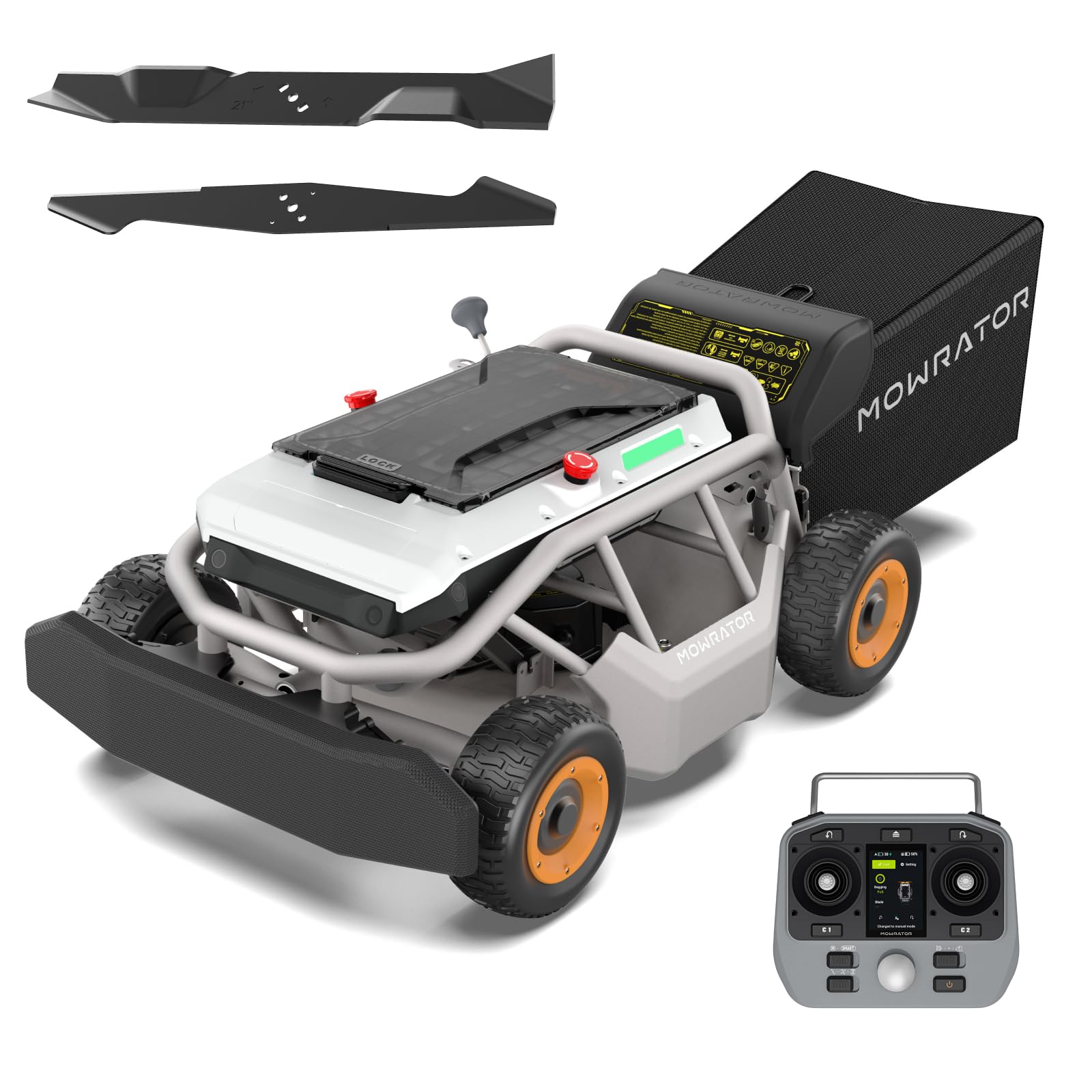
Mowrator S1 4WD 12Ah remote control lawn mower
See on AmazonThe 12Ah battery and what 1.5 hours really means
The 12Ah pack is rated for about 1 hour 30 minutes of running and up to 0.75 acres per charge, and it recharges in about 70 minutes on the included charger. Those are best-case numbers, and the gap between best case and your yard is the whole story of this battery.
Why runtime drops
Runtime follows load. Tall, thick or wet grass, sustained grades, a low cut and a dull blade all pull more current from the pack.
The acreage math
0.75 acres is a ceiling, not an average. It assumes continuous cutting with no stops to reposition, empty a bag or clear an obstacle.
Charging and swapping
The battery is detachable, so it charges indoors and a spare swaps straight in. Buyers on Amazon most often praise battery life among the machine's strengths, and the detachable design is what makes that praise practical.
LiFePO4 chemistry and storage
LiFePO4 has a long cycle life, keeps its power steadier as the pack drains and is a safer chemistry than typical lithium-ion. For winter, store the pack detached and indoors at about 70% charge, in a 32 to 95°F range. It self-discharges only 2 to 5% a month, so it holds that charge until spring.
Cutting performance
The 21-inch steel deck sits on an aluminum alloy body, with five cutting heights from 1.5 to 4.3 inches. That range covers a close trim along a path and a taller first cut when the season starts late. Cutting torque is ample for thick growth, and buyers on Amazon single out how it handles heavy, overgrown grass as one of the things they like most.
Tall grass and weeds
This is a machine built for growth that a typical push mower bogs down in.
Wet grass
Wet grass clumps, loads the deck and shortens runtime, and the machine is built for normal outdoor use rather than downpours.
Cut quality and blades
On maintained turf the cut is clean. On very tall growth expect a rougher first pass and a tidy-up second pass.
On slopes and how to use the 37° rating
The S1 4WD 12Ah is rated to 75% (37°) on the standard tires it ships with. Wide tires raise that to 85% (40°) and deformable tires to 119% (50°), and both are compatible accessories you add yourself. The rating is a capability, not a comfort level.
Why four-wheel drive matters here
Four independent wheel motors give the machine traction and control on grades a two-wheel-drive mower cannot hold. Buyers on Amazon praise the traction and report that it does not slip, which fits the 4WD design. If it cannot make a climb, it tends to slide back rather than tip, which is a meaningful safety characteristic on steep ground.
Safety behavior on a bank
Sensors slow and stop the blades if the machine tilts or flips. Four ultrasonic sensors and a front bumper protect it from obstacles.
Driving it, the remote and the view
A handheld remote with a fast response and dual antennas keeps a stable link, and you steer, speed up and slow down from the controller. Cruise control and automatic U-turns at the end of a pass make long rows less tiring. The point of the remote is distance: it keeps you out of the hazard zone on steep banks, in poison ivy, near bees or on rough ground.
The visibility limit
From a distance you cannot always see what the deck is about to hit. The ultrasonic sensors and the front bumper help, and an optional first-person-view camera kit gives a live view from the deck. The camera is an add-on, not part of the box.
Controller fatigue
A long session holding the remote tires the hands.
No app, no schedule
There is no app, no scheduling and no autonomous mode. You drive the S1 every time, which is the difference between this machine and a mower that runs on its own.
The trade-offs you accept with a remote control mower
Skid-steer steering pivots the machine by dragging its wheels, and that can scuff turf on tight turns, especially on soft or wet ground.
At 132 lb, it is not a one-person lift.
On heavy growth or steep ground, runtime drops well below the headline hour and a half. If your property is large or rough, the 12Ah pack is the limiting factor, and a spare battery or the larger pack belongs in the plan from the start.
The machine is built for normal outdoor use, not for downpours, so plan around the weather rather than mowing through it. And it is not autonomous: if what you want is a mower that runs on a schedule while you are at work, this is the wrong category of machine.
Buyers on Amazon are divided on value for money. Some find it worth the investment and others consider it pricey, and that split is an honest reflection of how differently owners weigh the capability against what they paid.
How it compares with other kinds of mowers
Riding mowers and zero-turn riders are faster on large, flat, open ground and you sit down to mow, but you are on the slope with them, and they cannot safely take steep banks or rough, narrow ground. Autonomous robot mowers are hands-off and schedule-driven, but they need a bounded, maintained lawn and cannot handle tall weeds, rough ground or steep banks.
Walk-behind brush mowers have similar capability on rough ground, but the operator stands right next to the hazard. Push and self-propelled mowers are simple and light, but slow on large ground and no help on steep or overgrown areas.
The S1 4WD 12Ah combines distance from the cut, four-wheel-drive traction on grades and a wide cutting range in one machine. That combination is the reason to choose it over any of the others.
The Mowrator S1 4WD 12Ah is a genuinely capable machine for the right yard: steep, rough, overgrown or hard to reach, where you want to cut from a safe distance. It is a poor fit for a large flat lawn or for anyone who wants a mower that runs itself.
If your lawn is at or above three-quarters of an acre, or mostly heavy growth, budget for a spare battery or the larger pack from the start. The one thing to remember is that this is a remote-controlled mower, not a robot: buy it to drive it.
It suits the homeowner with banks, ditches and brush who wants four-wheel-drive traction and a wide cutting range in one machine. It does not suit the homeowner with open flat ground who wants to sit down and mow fast. The product card shows the current price.
Frequently asked questions
How tall can grass be before the Mowrator S1 4WD 12Ah is out of its depth?
Mowrator rates the machine for grass standing up to 51 inches tall, well past what a typical walk-behind can take down.
Are there other versions of the Mowrator S1 besides the 4WD 12Ah?
Mowrator also offers a two-wheel-drive S1 and a larger battery pack than the 12Ah. The 4WD 12Ah is the four-wheel-drive model with the 12Ah LiFePO4 pack, and it is the entry point of the range: the smallest battery and the lowest slope rating of the three, since the wide and deformable tires that reach 40° and 50° are sold separately.
Is the Mowrator S1 4WD 12Ah easy and pleasant to operate?
Buyers on Amazon report that the Mowrator S1 4WD 12Ah is simple to handle and fun to drive, which fits a machine that holds a set speed and pivots on its own at the headland, so long passes need less input from the controller. The trade-off is that you still hold the remote for the whole session, and a long one tires the hands.