
McLane 25-9.50GT-10-GK Greens Keeper Reel Mower Review
When you buy through the Amazon links on this page, we may earn a commission at no extra cost to you. Learn more
Last updated October 31, 2026
Our McLane 25-9.50GT-10-GK Greens Keeper review finds it a good buy for one kind of owner: someone with a flat, level lawn of Bermuda, Paspalum or another fine turf kept very short, or a backyard putting green, who will keep up with the mowing and the sharpening. For a lawn mowed at 2 to 4 inches, a sloped or bumpy yard, or anyone who wants to set a height and forget it, it is the wrong machine.
It is a 25-inch gas reel mower with a 10-blade reel, a Briggs & Stratton 9.50 GT engine, a grooved front roller, rear roller drive, an all-steel heavy duty chassis, an induction heat treated bed knife and reel, Touch-A-Matic engine clutch controls, and belt and chain drives. The cutting height runs from 0.13 in (0.32 cm) to 2 in (5.08 cm) across 15 positions, which is putting-green and sports-turf territory.
What the McLane Greens Keeper does well
The machine is built around one job: cutting fine turf very short, cleanly, over and over. Everything it does well follows from that.
Cut quality at low height
A reel cuts like scissors, trapping the grass blade between the spinning reel and a fixed bedknife. With 10 blades on a 25-inch reel, the grass meets a cutting edge far more often per inch of travel than it would with a five- or seven-blade reel, and that frequency is what keeps a very short lawn even. The reel and the bedknife are induction heat-treated, so the cutting edges hold their hardness through the hours a low cut demands.
The grooved front roller
The front roller carries shallow grooves, and its job is to level and compact the soil in spring so the cut stays consistent across the lawn. In practice, a roller that presses the surface down before the reel arrives gives the blades a flatter, more uniform bed of grass to work on, which is exactly what a lawn cut under an inch needs.
Rear roller drive for traction
The drive goes through the rear roller rather than through separate drive wheels. That gives positive traction on a surface you keep short and firm, and it helps the aftercut appearance: the grass is rolled as it is cut, which is where the smooth, even look of a reel-mowed lawn comes from. It is not a full-width striping drum, so do not expect tournament-grade stripes.
Touch-A-Matic engine clutch
The Touch-A-Matic clutch control engages the reel and the drive. On a walk-behind machine of this size, a clutch you can work without fighting it matters over a full pass, and it lets you stop the reel without shutting the engine down.
Belt and chain drives
Two drive paths share the work, which adds reliability and keeps the mowing consistent and smooth. Fewer single points of failure in the drivetrain means fewer afternoons lost to a slipped belt.
All-steel heavy-duty chassis
The frame is steel throughout, in a red finish over alloy steel. That is what lets the machine carry its own weight and the load of a full catcher season after season, and it is also where the weight comes from.
Grass catcher included
The mower ships with a catcher, so clippings are collected instead of dropped in a windrow. At the heights this reel works at, a windrow of clippings would smother the turf underneath it.
The engine
The Briggs & Stratton 9.50 GT is a commercial-grade engine in that maker's lineup, with enough torque to spin a 25-inch 10-blade reel through fine turf without bogging down.
What it is meant for
The intended use is plain: ultra-precise cutting of Bermuda, Paspalum and other premium turf grass. That sentence is the best guide to whether this mower belongs in your shed.
Where the McLane Greens Keeper falls short
The limits are as specific as the strengths, and the first one rules the machine out for most lawns.
It is a low-cut machine only
The cutting height runs from 0.13 in (0.32 cm) minimum to 2 in (5.08 cm) maximum across 15 positions. The top of that range is around 2 inches, and the reel is at its best at the short end. A lawn kept at 2 to 4 inches, which is where most US homeowners mow, is outside what this mower is built to do well. Confirm the cutting-height range with the seller before you buy, because it is the one figure that decides whether the machine suits you at all.
Height adjustment is a deliberate job
Changing the cutting height means working through a bolt-and-rod procedure across 15 positions, not flicking a lever. You will not switch between green height and collar height in the middle of a mow, and you should plan the height for the season rather than for the afternoon.
Weight and size
The item weight is 240 lb, the machine is 50 inches deep and 45 inches high, and the cut is 25 inches wide. That weight makes it hard to turn at the end of every pass, hard to lift into a truck, and demanding of real storage space. Measure your gate, your shed door and your truck bed before you commit.
One fixed forward speed
It is a walk-behind with a single ground speed. The machine sets the pace, not you, so you walk at its rate across the whole lawn.
10 blades is a trade-off
A high blade count is an advantage at very short heights and a disadvantage higher up. The 10-blade reel is another sign that this is a short-grass tool.
Sharpening is ongoing and skilled
A reel mower only cuts well while the reel and the bedknife stay sharp and parallel. The manufacturer's guidance is that sharpening and backlapping be done by a properly equipped service center, so plan on periodic professional service.
No full-width traction drum
The rear roller drive helps traction and appearance, but this is not a dedicated greens mower with a full-width drum. Judge the stripes accordingly.
Debris sensitivity
Walk the lawn or blow it off before every mow.
Mowing cadence
The mower is the smallest part of that commitment.
The product in this review
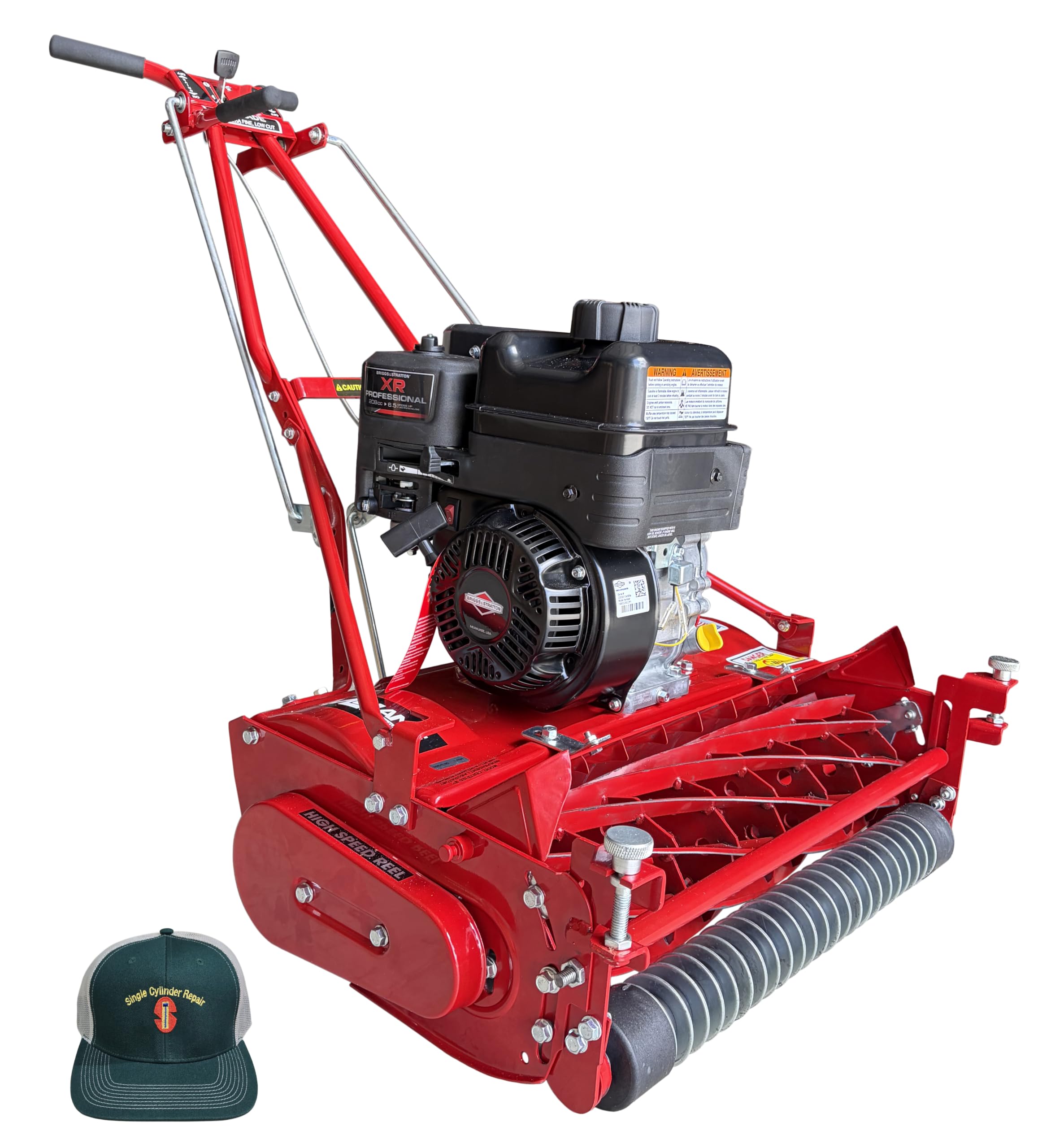
25 in. Greens Keeper McLane Reel Mower 25-9.50GT-10-GK
See on AmazonWhat the McLane 25-9.50GT-10-GK's Reel, Roller and Engine Figures Tell You Before You Buy
These are the figures that decide whether the machine fits your lawn, your gate and your routine.
| Specification | Figure |
|---|---|
| Cutting width | 25 in. |
| Number of blades | 10 |
| Engine | Briggs & Stratton 9.50 GT |
| Cutting height | 0.13 in (0.32 cm) minimum to 2 in (5.08 cm) maximum |
| Height positions | 15 |
| Drive | Rear roller drive, with belt and chain drives |
| Clutch | Touch-A-Matic engine clutch |
| Front roller | Grooved |
| Chassis | All-steel, heavy duty |
| Reel and bedknife | Induction heat treated |
| Catcher | Included |
| Weight | 240 lb |
| Depth | 50 in. |
| Height | 45 in. |
| Color and material | Red, alloy steel |
| Intended use | Ultra-precise cutting of Bermuda, Paspalum and other premium turf grass |
How to read the model number
The name carries the machine's whole story. 25 is the cutting width in inches, 9.50GT is the engine's torque rating, 10 is the number of blades on the reel, and GK marks the Greens Keeper series. Reading it that way lets you confirm you are looking at the right machine before you order.
What each figure changes for you
The 25-inch cut means fewer passes than a narrower reel but a wider machine to steer around beds and corners. The 240 lb weight is what you feel at every turn and every loading. The 50-inch depth and 45-inch height are what your storage has to swallow. The 15 positions give you fine control inside a narrow band, and the included catcher saves you buying one separately.
The McLane 25-9.50GT-10-GK Greens Keeper is a genuinely capable low-cut reel mower: an induction heat-treated reel and bedknife, a grooved front roller, rear roller drive and a commercial-grade engine, all on a steel chassis with a catcher in the box. It is also a machine with real limits: a cutting range that tops out around 2 inches, 240 lb to steer and store, a bolt-based height adjustment, and sharpening that belongs in a service center's hands.
It fits a homeowner with a flat, level Bermuda or Paspalum lawn kept very short, or a backyard putting green, who will commit to mowing twice a week and to the maintenance routine. It does not fit a normal-height lawn, a sloped or bumpy yard, or anyone without the appetite for frequent mowing and periodic sharpening.
Before you buy, confirm the cutting-height range with the seller, measure your gate and your storage, and line up a service center for sharpening and backlapping.
Frequently asked questions
The cutting height and the blade count decide almost everything about whether this reel belongs on your lawn, so check both against your own grass before you order.
How short can the McLane 25-9.50GT-10-GK Greens Keeper cut, and what is the tallest setting it offers?
At its lowest, the reel can be set to leave 0.13 in of grass, and the highest setting leaves about 2 in, with 15 positions in between. The machine cuts best near the short end of the range.
Does the 10-blade reel on the McLane 25-9.50GT-10-GK Greens Keeper work against it when the grass gets longer?
Yes, it can. Ten blades crowd the reel so tightly that once the turf passes about half an inch, the blades tend to ride over the tips rather than shear them, and you end up with ragged patches and a second trip over the lawn. The high blade count is an asset at very short heights and a drawback higher up.
What does changing the cut height involve on the McLane 25-9.50GT-10-GK Greens Keeper?
Moving between the 15 positions is a bolt-and-rod procedure rather than a lever flip. That makes the height something to settle on for the season, since switching from green height to collar height partway through a mowing pass is not practical.
Can you vary the walking pace on the McLane 25-9.50GT-10-GK Greens Keeper?
No, the mower runs at one fixed forward ground speed. The machine, not the operator, sets the pace for the whole lawn.
Will the McLane 25-9.50GT-10-GK Greens Keeper give a putting-green style striped finish?
You get a clean, uniform finish with a light roll to it, but not the bold light-and-dark bands of a ballpark or a tournament green. The rear roller is narrower than the full cutting width, so it cannot lay the whole swath in one direction, and the result reads as tidy rather than striped.